Thinking & conversation tools
An optional reference, kept apart from the rest of the app. Read it slowly, and read it inward first — the aim is to notice these patterns in your own thinking, not to catalogue them in someone else's.
Reasoning errors
Flaws in logic that weaken an argument. Most are not deliberate — they are shortcuts the mind takes when it is tired, defensive, or already sure.
Rhetorical techniques
Methods that persuade by moving around a fair discussion rather than through one. Worth recognising in yourself first — they are tempting precisely because they work.
Good-faith practices
Habits that keep a conversation open. None of them require agreement — only the willingness to understand before answering.
None of this is a checklist for other people. These are human tendencies, and every one of them is easier to spot in someone else than in yourself. The point is not to win the conversation — it is to stay in it honestly.
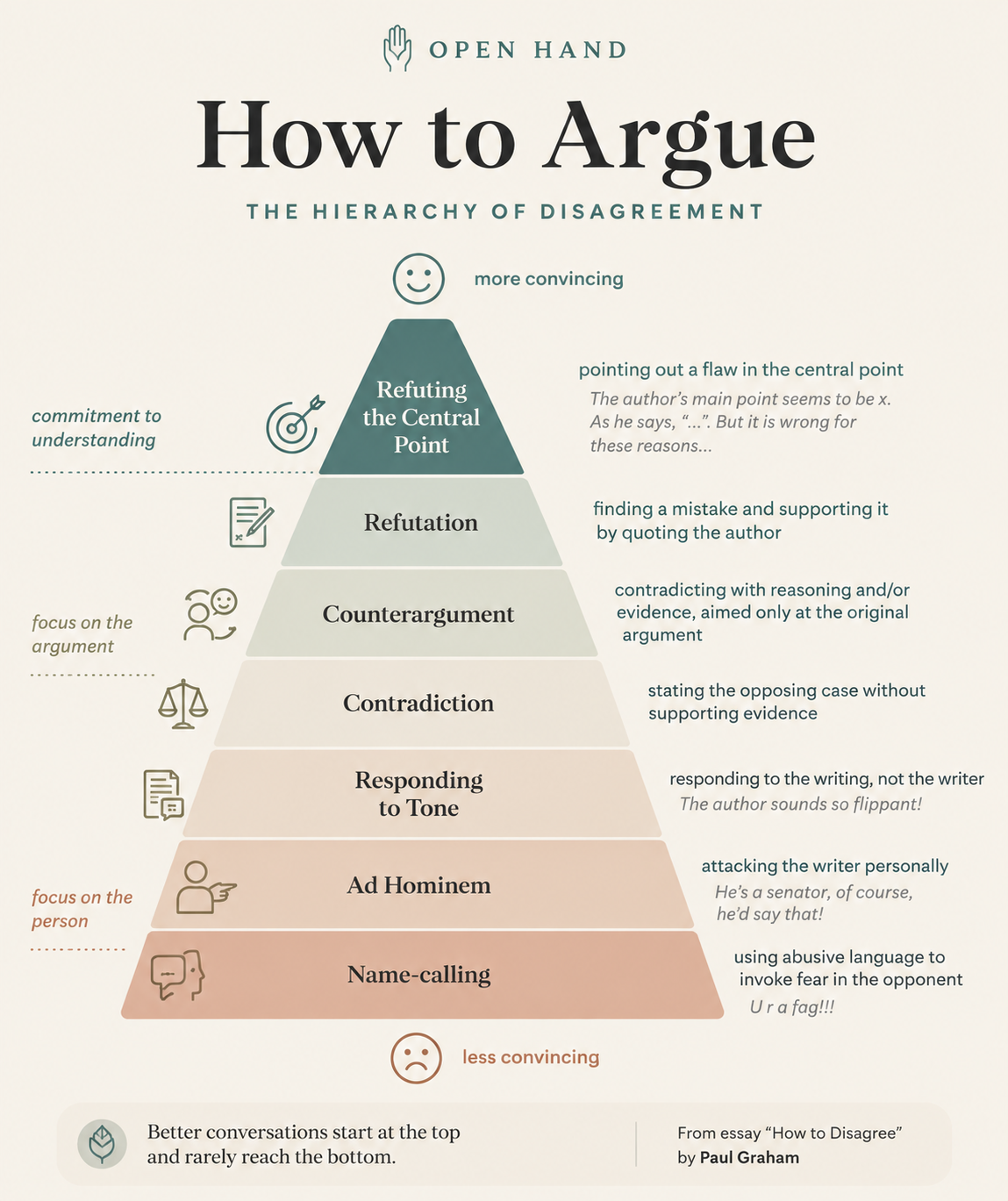
The hierarchy of disagreement
Optional supporting material. Paul Graham's ladder, from “How to Disagree”, sorts disagreement by how much work it actually does — from name-calling at the bottom to refuting the central point at the top. It sits alongside the Open Hand framework rather than inside it: the closed hand tends to pull a conversation downwards, and the open hand is what it takes to stay near the top.